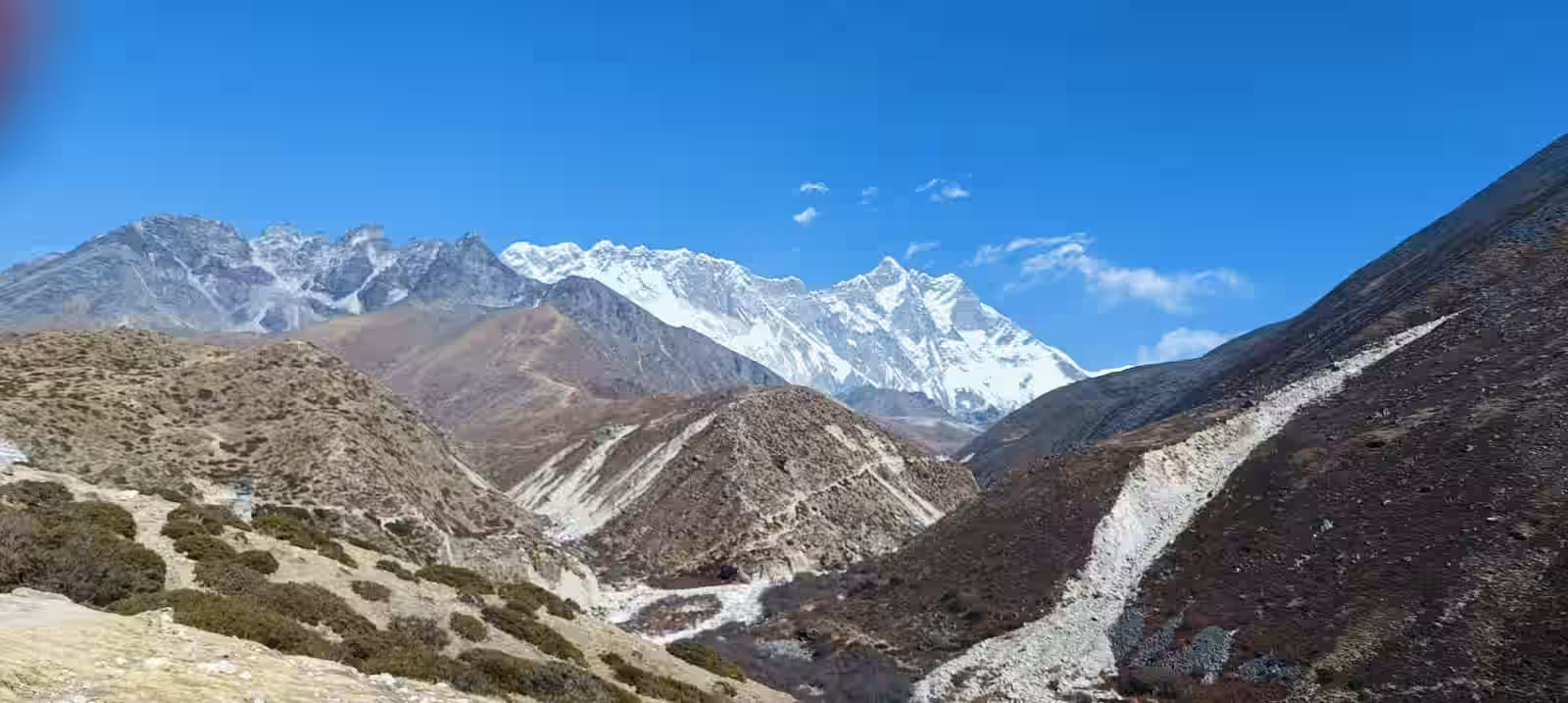
The Everest Base Camp trek cost in 2026 ranges from $800 to over $8,000 . Before you start your journey, do not skip this part. You need to know how much exactly Everest Base Camp Trek costs in total.
It will definitely lessen your unnecessary burden on the trek. Imagine you are on a trek but you did not do your budgeting and run out of money. Problems right ?
Two trekkers can walk the exact same trail, sleep under the same sky, and spend wildly different amounts.
The difference comes down to the choices each person makes before they ever reach Nepal. The factors are budget tier, trek style, season, gear, and a handful of costs that most guides never mention all shape the final number.
This post helps you know every cost category in the order you will face it permits first, then flights, accommodation, food, and guide fees.
EBC is one of the most rewarding treks in the world, but it is also one of the easiest to over-spend or under-budget on.
Trekkers who plan with real numbers arrive prepared, spend less on avoidable surprises, and focus on the trail instead of the bill.
The figures in this post reflect actual 2026 costs from the trail. You can use them to build a budget that fits your version of the trek.
Most important is you can contact Himalayan Odyssey for more accuracy.
What Does the EBC Trek Cost in 2026?
The most important thing is .Your budget and your actual cost. Here is a quick overview of all three budget tiers. Let’s see the independent, mid-range and budget trek below.
Find your range and you can read the sections listed below to understand in a better way.
Use it to find your range, then read the sections below to understand exactly what drives each number.
Budget Style | Estimated Total Cost ( USD ) | What It Includes |
|---|---|---|
Budget/ Independent | $800-$1200 | Basic teahouses, local meals, self-guided |
Mid-Range / Guided | $1500-$2,500 | Guided group tour , comfortable teahouses |
Luxury / Lodge Trek | $4,000- $8000+ | Luxury lodged , private guide, Helicopter option |
These figures cover the trek itself . Lukla to EBC and back. They do not include international flights to Kathmandu. You will find those costs broken down in the flights section below.
Cost Breakdown Every Expense You Will Face
It is always the best idea to be prepared for every problems. You need to know how much money is enough for you.
There are certain expenses like, expenses for Sagarmatha National Park Entry, Trekker’s Information (TIMS Card ) and so on.
Do you know how much exactly, it costs ? If not, Himalayan Odyssey is here to guide you, worry not.
Work through each one and you will have a clear picture of your full EBC trek budget below:
Permits and Fees
The first cost you face is permits. All trekkers must hold two permits before they set foot on the trail. There are no exceptions, regardless of your budget level or the season you choose to trek.
Permit | Cost (USD ) | Where to Get It |
|---|---|---|
Sagarmatha National Park Entry | ~$30 | Monjo checkpoint or Kathmandu |
TIMS Card ( Trekker’s Information ) | ~$20 | Nepal Tourism Board, Kathmandu |
Total Permits | ~$50 | Nepal Tourism Board , Kathmandu |
Together, these two permits cost around $50. This is a fixed cost for every trekker, no matter which budget tier you fall into.
The key difference is how you get them. Independent trekkers must sort both permits in Kathmandu before they leave for Lukla. If you book a guided tour from Himalayan Odyssey, we handle it for you .
Kathmandu to Lukla (Flight)
Once your permits are in managed, your next major cost is the flight to Lukla . This short but famous flight is one of the most variable expenses on the trek.
The price changes based on the type of flight you book and the season you fly.Let’s check them below:
Option | Cost (USD ) | Notes |
|---|---|---|
Schedule flight (one way ) | $ 180- $220 | Subject to weather cancellation |
Helicopter charter ( one way ) | $400- $550 per seat | Most reliable ; groups of 5 share cost |
Helicopter ( full private charter ) | $ 1,500-$ 2,200 | Fastest and flexible |
Most budget trekkers choose a scheduled flight. It is the cheapest option, but it carries real risk. Lukla sits at high altitude and weather changes fast.
Delays of one to three days are common during shoulder seasons.
Shoulder season is the travel period between peak and off-peak seasons (typically spring: April–May; fall: Sept–Nov.
Make sure you always build buffer days into your plan and factor in the extra cost of waiting nights in Lukla or Kathmandu.
Note : If your trek dates are fixed and you cannot afford a delay, a helicopter charter is worth the extra cost. A group of five can share the price and make it much more affordable.
Accommodation Teahouses Along the Trail
As you move from the Lukla flight toward base camp, your accommodation costs will rise with every step. Teahouse prices increase with altitude .
It is because supplies are harder to transport higher up the mountain. Due to Nepal’s geography it is extremely difficult to take things high above.
Elevation Zone | Budget Teahouse (USD/night ) | Mid-Range (USD /night ) | Luxury Lodge (USD/night) |
|---|---|---|---|
Lukla-Namche (lower) | $5-$10 | $15-$25 | $80-$150 |
Namche-Dingboche (mid) | $8-$15 | $20-$35 | $120-$200 |
Lobuche- Gorak Shep (high) | $10-$20 | $25-$40 | Limited options |
One thing to know about budget teahouses is that many offer the room at very cheaper rate. Sometimes even free . But it depends on the condition . You can get rooms if only you eat all your meals at teahouses.
This is a very common arrangement on the lower sections of the trail. It sounds like a good deal, but it means your food costs at that teahouse are not negotiable.
Now that we have known about the accommodation and costs, let’s see what are the basic food and drink cost on the trail.
Food and Drink on the Trail
Food is one of the most overlooked costs on EBC. Trekkers often underestimate it. Like accommodation, food prices increase with altitude.
A simple meal that costs $5 at Lukla can cost $14 at Lobuche. Over 14 days, those differences add up fast.
Item | Lower Elevations (USD ) | Higher Elevations (USD ) |
|---|---|---|
Dal Bhat (main meal) | $5-$7 | $9-$14 |
Breakfast ( porridge/eggs) | $4-$6 | $7-$10 |
Coffee/tea | $1-$2 | $2-$4 |
Bottled water (1L) | $1-$2 | $3-$5 |
Snickers/chocolate bar | $1-$2 | $3-$5 |
If you are a first timer in Nepal, you might not be familiar with Dal Bhat. But trust us Dal Bhat is always the best value meal on the trail.
It is filling, nutritious, and often comes with free refills. Make it your go-to meal above Namche. For drinks, you can carry a reusable bottle and use iodine tablets or a filter. It makes the water drinkable.
Buying bottled water above Namche adds up quickly and becomes one of the biggest surprise costs for unprepared trekkers.
Guide and Porter Costs (If Trekking Independently)
If you decide to trek without a guided tour package, hiring a guide and porter is the next cost you need to be prepared for.
These rates are standard across the industry, though they can be slightly different between agencies and seasons.
For more accurate cost and details, you can contact us.
Role | Daily Rate (USD) | Notes |
|---|---|---|
Licensed guide | $25- $35/day | Compulsory on some restricted routes; strongly recommended |
Porter (per bag ) | $15-$25/day | Typically carries to 25kg |
Porter-guide combo | $30-$40/day | Cost-effective option for solo trekkers |
When you calculate these costs, always include more than just the daily rate.
Your guide and porter need accommodation and food on the trail too, and you are responsible for covering those above costs.
You should also factor in their insurance.
Paying a fair wage and covering these basics is both the moral approach and the one that The Himalayan Odyssey also requires.
Note : A porter-guide combo is the most cost-effective choice for solo trekkers. You get navigation support and load carrying in one person at a lower combined daily rate.
Which Costs Less? Guided vs. Independent
This is one of the most common questions trekkers ask when they want to know about EBC trek cost. The honest answer is that it depends on what you count as a cost.
Here is a direct comparison across all three options: budget, guided group, and private guided so you can make the right call for your situation.
Let’s check them below:
Factor | Independent | Guided Group Tour | Private Guided |
|---|---|---|---|
Typical total cost | $800-$1,400 | $1,400-$2,500 | $2,500-$4,500 |
Permits | Self-arranged | Included | Included |
Lukla flights | Self-booked | Usually included | Included |
Flexibility | High | Low-moderate | High |
Safety net | Personal | Group + Guide | Guide + agency support |
Best for | Experienced trekkers | First-timers, solo travellers | Those wanting full service |
Independent trekking looks kinda cheaper on paper. But the gap between independent and guided costs is often smaller than it appears.
Hidden costs rebooked flights, wrong teahouse choices, and emergency extras close that gap quickly.
A guide who knows the trail, handles logistics, and supports you at altitude, a guided group tour often works out to better value for money.
This is especially true for first-time trekkers who have not been to Nepal before.
That said, experienced trekkers who know the route, speak some Nepali, and travel light can manage independently without issue.
The best option is the one that matches your experience, your risk tolerance, and how much planning you want to do yourself.
Budget vs. Mid-Range vs. Luxury (Full Day-by-Day Spend)
You will now see a full breakdown across a 14-day trek below .These are trail-only costs.
They do not include permits, flights, or gear, which are listed separately later in this post.
Below is tour budget sheet,
Expense category | Budget (USD /day ) | Mid- Range (USD/day ) | Luxury(USD /day ) |
|---|---|---|---|
Accommodation | $5 | $20-$35 | $100-$200 |
Food and drink | $15-$25 | $30-$45 | $60-$100 |
Extras ( tips , snacks, charges) | $3-$5 | $5-$10 | $10-$20 |
Daily Total | $23-$45 | $55-$90 | $170-$320 |
14-Day Trek Total | $320-$630 | $770-$1,260 | $2,380-$4,480 |
The above listed daily totals show how quickly costs separate between tiers, especially once you pass Namche.
A budget trekker spending $30 a day and a luxury trekker spending $250 a day are both on the same trail. It is not necessary that they spend the same expenses. They are definitely living very different experiences of it. Neither is wrong. We mean to say expenditure varies person to person.
What matters is that you have to budget the trek wisely. It is always better to have enough money than run out of money.
Now that you have the main daily costs, it is time to look at the expenses that most trekkers forget to plan for.
These hidden costs have caught out many well-prepared trekkers. They can add hundreds of dollars to your total if you are not ready for them. Some can also try to fool you.
Do you know about hidden costs that most blogs don't mention ?
Now that you have clicked on this blog, we know you are really interested for Everest Base Camp.
Every experienced EBC trekker has a story about a cost they did not see coming. These six expenses are consistently left out of EBC cost guides but they are very real.
Add them to your budget before you book.
Gear and Equipment
Good gear is not a nice-to-have on EBC, it is a safety requirement. A quality sleeping bag, down jacket, and trekking poles will set you back $200–$600 if you buy new.
If you are not ready to invest in gear, Kathmandu's Thamel district has a wide range of reliable rental options for $50–$120. You can go from shop-to-shop and rent it for your trek.
Thamel is also a lively city here in Nepal. Don’t miss to explore it.
Main thing is whatever you do, do not cut corners on boots. Also, do check your boots properly to avoid future problem.
Blisters and ankle problems are among the most common reasons trekkers. Some even give up before reaching base camp. Be prepared to tackle any problems.
Travel Insurance
Travel insurance is the one cost on this list you should never skip. Never means never.
EBC takes you above 5,000m, and at that altitude, a serious illness or injury can require a helicopter evacuation. Sounds costly, right ?
To be fair, without insurance, that rescue can cost $3,000–$6,000 out of pocket. See, we told you !
Your insurance is a solid policy that covers high-altitude trekking and helicopter evacuation costs $80–$200 depending on your nationality and how long you need it.
That is a small price compared to the alternative. Make sure your policy specifically covers trekking above 5,000m many standard travel policies do not.
→ [Insurance requirements for EBC trekking](#ebc-permits-guide)
Charging and WiFi
You might think internet is free everywhere. But a big, No. The internet you find anywhere on your trek is slow. Why, because of Nepal’s geography.
Above Namche, you will find electricity as a paid service. Charging your phone, camera, or power bank costs $1–$3 per device per charge.
WiFi, where it is available, costs $3–$8 per session. These small charges will surely add up over 14 days.
Budget $30–$60 for the full trek to cover charging and connectivity needs.
If you want to cut this cost, best is you carry a portable solar charger.
Tips for Your Guide and Porter
Tipping is a normal and expected part of trekking culture in Nepal. Your guide and porter work hard in difficult conditions, and a fair tip matters. When we say work hard, they really do work hard.
The standard is $8–$15 per day for a guide and $5–$10 per day for a porter.
On a 14-day trek, that means budgeting $112–$210 for your guide and $70–$140 for your porter. Pay in cash at the end of the trek.
This cost is separate from their daily rate and should be treated as a fixed part of your budget, not an optional extra.
Buffer Days in Kathmandu
Lukla is one of the most weather-affected airports in the world. Flight delays of one to three days are not rare; they are routine during shoulder seasons.
Always budget for at least one or two extra nights in Kathmandu, at $30–$80 per night depending on your accommodation tier.
More importantly, do not book your international departure flight too close to your scheduled Lukla return.
A missed international connection because of a Lukla delay is an expensive and stressful mistake that many trekkers make only once. Be wise and smart.
Shopping in Namche Bazaar
If you have not heart of this, Namche Bazaar is the gateway to Namche Bazaar.
It is also the main resupply point on the EBC trek. You will find excellent gear shops, warm clothing, and local crafts.
It is easy to walk in for a quick browse and walk out having spent $50–$150 without fully noticing.
If you plan to shop, make sure you set a budget before you arrive and stick to it.
Many trekkers also find that they need to replace gear here like a warmer layer, a better pair of gloves .
Make sure you keep a small buffer for practical purchases too.
Does Season Affect the Everest Base Camp Trek Cost?
Yes ,it is obvious that the seasons affect Everest Base Camp trek.
Do you know the EBC trail runs year-round, but demand is not the same across all seasons. Higher demand means higher prices, and lower footfall means real savings. Let’s see more about this now:
Season | Impact on Cost | Notes |
|---|---|---|
Spring ( Mar-May) | Peak Pricing | Teahouses ;April is most expensive |
Monsoon (Jun-Aug) | 20-30% cheaper | Teahouse discounts; flight delays add risk costs |
Autumn (Sep-Nov) | Peak pricing | October rivals April for demand |
Winter(Dec-Feb) | Cheapest overall | Fewest trekkers; some teahouses close above 4,000m |
Spring and autumn are the two peak seasons on EBC. April and October are the most popular months, and teahouses charge accordingly. There are more number of trekkers if you have to compare it.
It is because you have the most demanded views, the most demanded weather at spring and autumn
But, monsoon season is the off-season. This is why you might get monsoon season discounts 20 to 30 percent. The teahouses also place lower rates in many places . You can also expect the flight delays. There are more frequent and the wet trails so if you have to trek, trek at your own risk.
Likewise , winter is the cheapest time to trek. You will find the fewest trekkers on the trail. Like monsoon some teahouses above 4,000m close entirely. It is because of the cold weather.
Note : If you want a good balance of cost, conditions, and experience, you can choose for November or early March.
You get stable weather, a well-maintained trail, and slightly lower prices than the peak months on either side.
Total Cost Summary All In, by Budget Style
Now that you have seen every cost in detail, let’s see some more below.
This table pulls together all the numbers from this post into a single all-in summary. Use it to build your personal budget and screenshot it for your planning notes.
Cost Item | Budget ( USD) | Mid-Range (USD) | Luxury (USD) |
|---|---|---|---|
Permits (TIMS + SNP ) | $50 | $50 | $50 |
Lukla flights ( return ) | $360-$440 | $360-$440 | $800-$1,100 |
Accommodation (14 nights ) | $70-$210 | $280-$490 | $1400 |
Food and drink (14 days) | $210-$350 | $420-$630 | $840-$ |
One thing to notice in this table is how close the budget and mid-range grand totals are.
The difference between trekking independently and booking a guided group tour is often just a few hundred dollars.
When you weigh that against the value of having local expertise, logistics support, and a safety net on the mountain, many trekkers find that mid-range guided travel is the more sensible choice .
even if independent trekking looked cheaper at first glance.
Frequently Asked Questions
These are the questions we hear most often from trekkers planning their EBC budget. If you have read through this post, you will already know most of the answers.
But here they are in one place for easy reference. Because we care for you.
What is the minimum budget for the EBC trek?
Plan for at least $1,000–$1,200 all-in if you are trekking independently on a tight budget. Going below this means cutting corners on essentials like travel insurance or a licensed guide.
Both are safety-critical on a high-altitude trek, and the savings are not worth the risk.
Is EBC cheaper than Annapurna Base Camp?
The two treks are broadly comparable for mid-range trekkers. But, EBC costs slightly more overall. It is because of the Lukla flight and the higher permit fees.
Annapurna Base Camp can be done for a little less. This is because it is accessible by road and does not require a flight towards the trailhead.
Can I pay in USD on the trail?
Yes. Most teahouses accept USD alongside Nepali Rupees. USD is widely recognised on the trail. That said, there are no ATMs above Namche Bazaar.
So, make sure you withdraw enough cash in Kathmandu before you fly to Lukla, or top up in Namche before you head higher. Running out of cash above Namche is a stressful and unavoidable problem.
Does the guided tour price include flights from my home country?
No. All costs in this guide cover Nepal only that also from Kathmandu to EBC and back. International flights to Kathmandu are a separate expense . They vary widely depending on your origin and the time of year you book.
Always factor them into your total trip budget.
How much should I tip my guide and porter?
The standard rate is $8–$15 per day for a guide and $5–$10 per day for a porter. On a 14-day trek, that works out to roughly $112–$210 for your guide and $70–$140 for your porter.
Make sure you collect the cash before your last trail day and pay at the end of the trek.
Tipping in the local currency, Nepali Rupees, is also perfectly acceptable and often preferred.
Conclusion
Everest is not just a journey , it is a brand in Nepal. From the $50 permit fee at the start to the tipping conversation at the end, every line item is on the table.
The total you spend will depend on the choices you make your accommodation style, whether you go guided or independent, how you handle the Lukla flight, and whether you budget for the hidden costs that most guides leave out.
There is no wrong budget for EBC.
A trekker spending $1,200 and a trekker spending $6,000 can both reach base camp and have the experience of a lifetime. What separates a great trek from a stressful one is not how much you spend .
It is how well you plan. Use the numbers in this post to build a budget that matches the trek you actually want to do, not the one that just looks good on a spreadsheet.
For your more accurate budgeting contact HimalayanOdyssey.